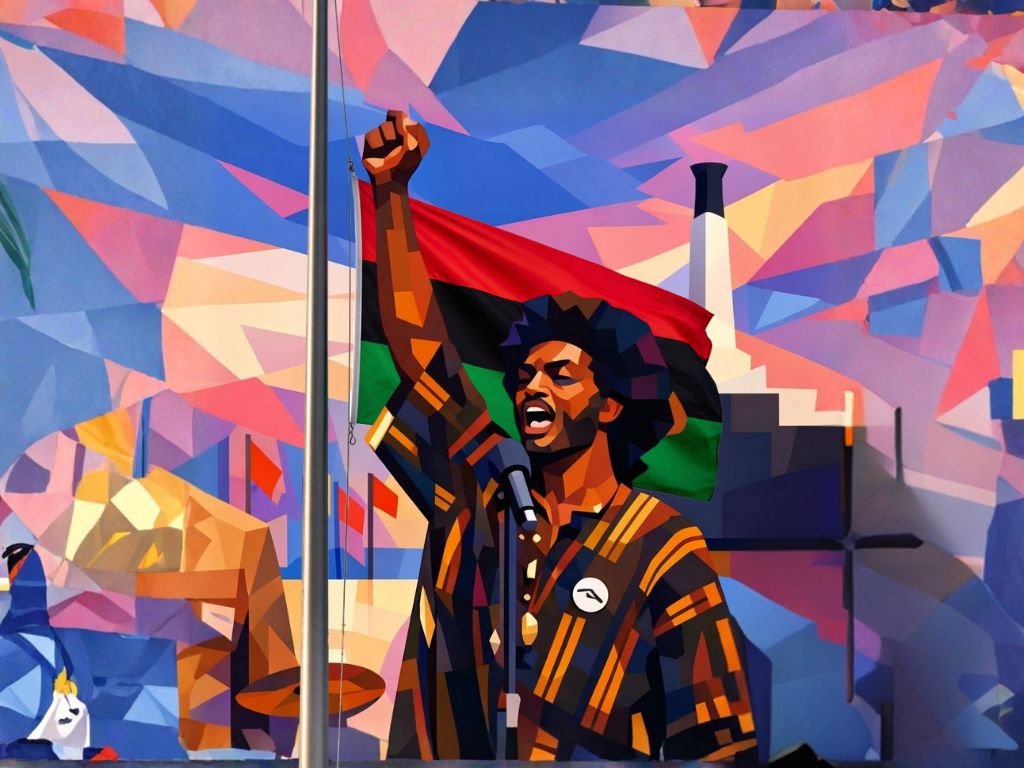
By Chuck “Jigsaw” Creekmur and featuring Dr. Nola Haynes, Ashton Burrell, Jineea Butler and Hip-Hop.
“Brothers and sisters…brothers and sisters…I don’t know what this world is coming to.” – Rev. Jesse Jackson, the opening line to Public Enemy’s “Rebel Without A Pause”
Flags at half-mast speak loudly about who a nation chooses to honor.
They’re not simply fabric. They’re a signal of values. Charlie Kirk, a community college dropout, non-politician, non-military vet and documented racist, died by a bullet to the neck. United States president Donald Trump quickly lowered the American flag nationwide to denote we were mourning. The underlying message: this is what is important to us as a collective.
And sometimes, our values – and projected by leaders – reveal difficult truths.
Rev. Jesse Jackson was civil rights giant, global negotiator, two-time presidential candidate, college graduate and even mentor to Hip-Hop’s moguls. He was a powerful voice for Black dignity that passed away after a lifetime of service. But the national response didn’t come close to matching the size of his impact.
That contrast says something.
Because Jesse Jackson wasn’t just a man who marched with Dr. Martin Luther King Jr. He was part of the architecture that expanded democracy and equality in America. He pushed corporations to hire Black executives, he registered voters, he negotiated for hostages abroad and more. He told Black youth, “I am somebody.” In fact, he told all young that profound message.
And we believed him. I believe him as a young kid. That message echoed through the decades.
For many of us coming up, that phrase was a mantra. It gave us permission to imagine bigger futures in a country that didn’t always imagine us at all.
I met Rev. Jackson through interviews and Rainbow PUSH panels. He was always sharp, strategic, kind—and honest. Sometimes he critiqued Hip-Hop. That came from a generation defined by survival, where respectability politics felt like protection. But he evolved and he listened. And then he embraced us.
He saw that Hip-Hop could be power.
He told artists to own businesses, hire our people…build institutions. He saw Jay-Z, Russell Simmons and Diddy more than as celebrities—but as signs of Black economic independence.
“It’s another phase of our Civil rights struggle to become a more perfect union,” Rev. Jackson once told me. “to become a stronger, protected people. We’re now free, but we’re not equal. There is a difference—you can be out of slavery, out of Jim Crow, and still starve to death.”
In his later year, he continued to do the work, even as he was criticized for being out of touch.
Jineea Butler of the Hip-Hop Union, who worked closely with him, said:
“Reconnecting with the Hip-Hop community was deeply dear to his heart. He believed in our power—and challenged us to use it in ways that could help lead the world into its next evolution… I am somebody, and he was a Citizen of Hip-Hop.”
Dr. Nola Haynes, noted professor at Georgetown University’s School of Foreign Service, added:
“Jesse Jackson stands as a giant in the fight for equality—a living legacy of civil rights when those ideals are under constant threat. His unwavering commitment to justice and advocacy for Black Americans has inspired generations, reminding us that the struggle for freedom and dignity is ongoing. As Nas poignantly stated, ‘Jesse Jackson taught me to stand up and fight for what I believe in’ (Nas). In a world where systemic challenges persist, Jackson’s voice resonates through Hip-Hop, urging artists to carry the torch of activism and to confront oppression with courage and creativity.”
And activist Ashton Burrell remembered the personal side:
“Rev. Jesse Jackson is not only part of Black history, but of American and universal history forever… We lost a legend, but he will not be forgotten.”
That’s Jesse Jackson’s real legacy.
A bridge between Civil Rights and Hip-Hop. He was a warning that fame without ownership is temporary and fleeting. He preached freedom without economics isn’t freedom at all.
But here’s the hard part.
I went to a Sixers game and as we celebrated the birthday of b-ball icon Julius “Dr. J” Erving and also the 250th anniversary of the United States…there was no nod to Rev. Jackson. When a nation struggles to visibly honor a man like Jesse Jackson, it raises a question: Who do we as a nation value—and why?

Jackson was imperfect. Polarizing at times. One OG told me, “Jesse was prickly and combative when he was young. But he was a front-line soldier for equality.” Without his moves, Black America—and Hip-Hop—would look very different.
But, look around and you must notice Jesse Jackson’s spirit still moving among us.
He told us to “Keep Hope Alive.”
Now it’s on us to keep leadership alive.
Because giants leave big shoes.
And instead of tearing down the next generation, we need to start asking:
Who’s ready to step into them?
Rest in power, Rev.
Our flag is already lowered.
I think about one of my absolute favorite songs, “Rebel Without A Pause” and how Rev. Jackson set that song off.
“Brothers and sisters…brothers and sisters…I don’t know what this world is coming to.”
The culture knows what he meant. We have our own universal flag.